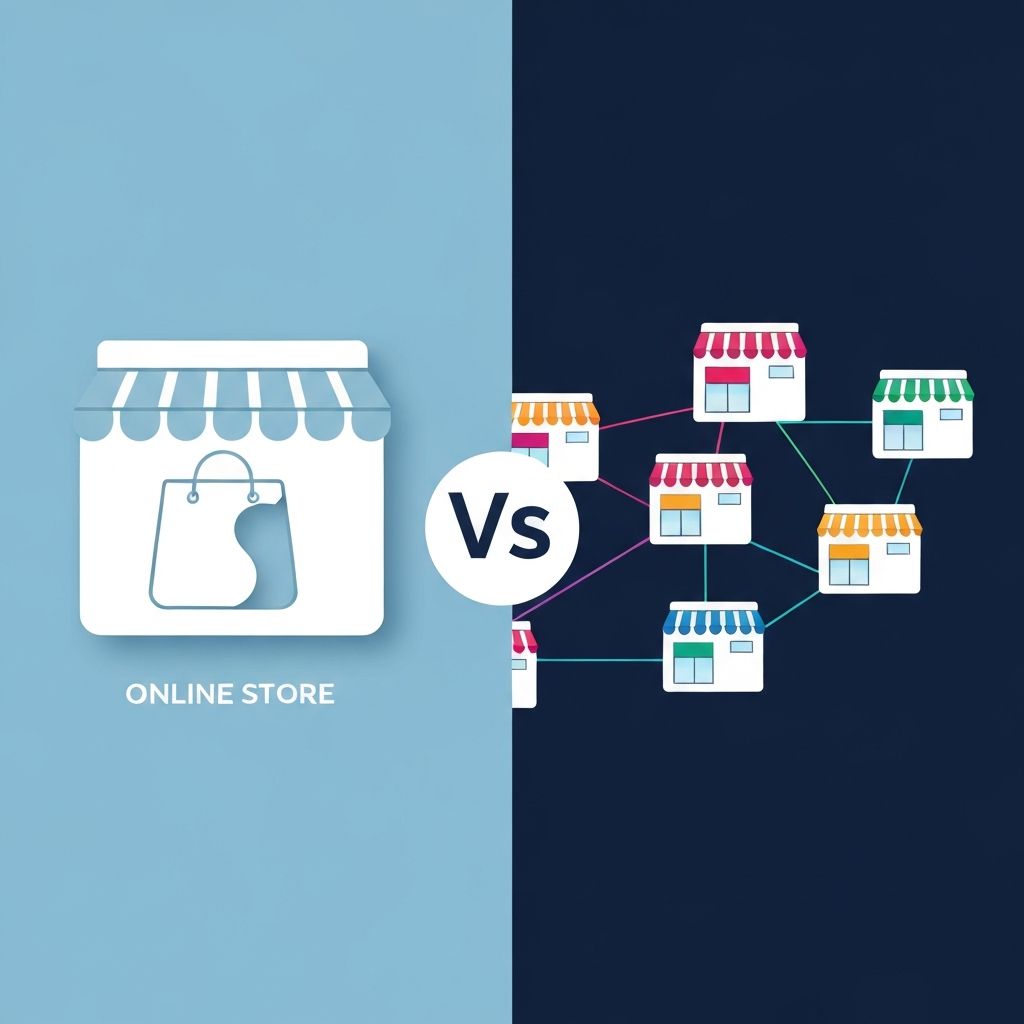
Shopify Collective vs YouPurr: Which Multi-Vendor Platform Is Right for Your Business?
22 March 2026
9 min read

Choosing the right multi-vendor platform is one of the most critical decisions you'll make when building your ecommerce business. Two popular options that frequently come up in conversation are Shopify Collective and YouPurr. While both enable you to sell products from multiple vendors, they take fundamentally different approaches to the multi-vendor platform model.
In this comprehensive comparison, we'll examine how Shopify Collective and YouPurr differ in their approach to multi-vendor ecommerce, helping you determine which platform aligns best with your business goals.
Understanding the Multi-Vendor Platform Landscape
Before diving into the specifics, it's important to understand what a multi-vendor platform actually is. A multi-vendor platform allows multiple independent sellers to list and sell their products through a single storefront or marketplace. This model has exploded in popularity, with platforms like Amazon, Etsy, and eBay proving the viability of the marketplace approach.
The global multi-vendor platform market continues to grow as entrepreneurs recognise the benefits of aggregating products from multiple sources rather than managing inventory themselves.
What Is Shopify Collective?
Shopify Collective is Shopify's solution for retailers who want to expand their product catalogue by partnering with other Shopify merchants. Launched as part of Shopify's B2B and wholesale initiatives, Shopify Collective allows you to sell products from other Shopify stores without holding inventory.
How Shopify Collective Works
With Shopify Collective, you connect with suppliers who are also on Shopify. When a customer places an order on your store, the supplier fulfils it directly. You set your own retail prices, and the difference between your price and the supplier's wholesale price becomes your margin.
The key characteristics of Shopify Collective include:
- Shopify-to-Shopify only: Both you and your suppliers must be on Shopify
- Dropshipping model: Suppliers handle fulfilment directly
- Curated partnerships: You manually invite and approve suppliers
- Integrated with Shopify admin: Managed entirely within your Shopify dashboard
What Is YouPurr?
YouPurr is a purpose-built multi-vendor platform designed from the ground up for marketplace businesses. Unlike Shopify Collective, YouPurr is a comprehensive marketplace solution that supports vendors from any ecommerce platform, not just Shopify.
How YouPurr Works
YouPurr provides a complete multi-vendor platform infrastructure including a customer-facing marketplace storefront, vendor management tools, commission handling, and integrations with major ecommerce platforms like Shopify, WooCommerce, Adobe Commerce, and Wix.
The key characteristics of YouPurr include:
- Platform agnostic: Vendors can connect from Shopify, WooCommerce, Adobe Commerce, Wix, or use the built-in product management
- True marketplace model: Operates as a distinct marketplace with its own brand and customer base
- Automated vendor onboarding: Self-service vendor registration and approval workflows
- Built-in commission management: Automatic commission calculation and vendor payouts
Shopify Collective vs YouPurr: Feature Comparison
Let's examine how these two multi-vendor platform solutions compare across key features.
Vendor Onboarding and Management
Shopify Collective requires you to manually discover and invite suppliers. You'll need to find Shopify merchants willing to partner, negotiate terms, and manually add their products to your catalogue. This works well for curated, boutique-style product expansion but becomes time-consuming as you scale.
YouPurr offers automated vendor onboarding with self-service registration. Vendors apply to join your marketplace, you approve them (manually or automatically based on criteria), and they can immediately start listing products. This multi-vendor platform approach scales much more efficiently for marketplace businesses with ambitions to onboard dozens or hundreds of vendors.
Platform Compatibility
Shopify Collective only works with Shopify merchants. If a potential supplier uses WooCommerce, Adobe Commerce, or any other platform, they cannot participate in your Shopify Collective network.
YouPurr supports vendors from multiple platforms. Whether your vendors use Shopify, WooCommerce, Adobe Commerce, Wix, or no platform at all (using YouPurr's built-in inventory management), they can all sell through your marketplace. This platform-agnostic approach to multi-vendor platforms gives you access to a much larger pool of potential vendors.
Pricing and Commission Models
Shopify Collective operates on a wholesale pricing model. Suppliers set their wholesale prices, you set your retail prices, and the margin is yours. However, you still pay Shopify's standard transaction fees on top of your subscription.
YouPurr offers flexible commission structures. You can charge vendors a percentage commission on sales, fixed fees per transaction, subscription fees, or any combination. This multi-vendor platform gives you more control over your revenue model and aligns with how most successful marketplaces operate.
Brand and Customer Experience
Shopify Collective products appear on your Shopify store alongside your own products (if you have any). The customer experience is that of shopping on your branded Shopify store, with fulfilment coming from various suppliers.
YouPurr creates a distinct marketplace experience. Customers understand they're shopping a multi-vendor platform with multiple sellers. Vendor storefronts, ratings, and reviews create transparency while your marketplace brand sits at the top level. This is the model used by Amazon, Etsy, and other successful marketplaces.
Scalability
Shopify Collective is designed for retailers looking to expand their product range, not necessarily for building a large-scale marketplace. Manual supplier management and the Shopify-only limitation constrain growth.
YouPurr is built for scale. The multi-vendor platform architecture supports unlimited vendors, automated workflows, and enterprise features like native mobile apps (on the Enterprise plan). YouPurr was developed by founders who scaled their own marketplace to eight figures before launching the platform commercially.
Advantages of Shopify Collective
Despite its limitations, Shopify Collective has genuine strengths for certain use cases:
Seamless Shopify Integration: If you're already invested in the Shopify ecosystem, Shopify Collective integrates natively without additional software or learning curves.
Simple Setup: Getting started with Shopify Collective is straightforward if you already have relationships with other Shopify merchants.
Lower Initial Complexity: For small-scale product expansion (adding 10-50 products from a handful of suppliers), Shopify Collective is less complex than setting up a full marketplace.
No Additional Platform Costs: Shopify Collective is included with your Shopify subscription, so there are no extra monthly fees beyond what you already pay.
Limitations of Shopify Collective
However, Shopify Collective has significant constraints for serious multi-vendor platform ambitions:
Shopify Lock-In: The requirement for all suppliers to be on Shopify eliminates a huge portion of potential vendors. Many excellent brands use WooCommerce, Adobe Commerce, or other platforms.
Not a True Marketplace: Shopify Collective is more of a dropshipping/wholesale arrangement than a genuine marketplace. There's no vendor storefront, no vendor ratings, and no marketplace community.
Manual Scaling: Adding each new supplier requires manual outreach, negotiation, and setup. This doesn't scale efficiently for marketplace businesses.
Limited Revenue Models: You're restricted to margin-based revenue (wholesale vs retail pricing). You can't charge listing fees, subscription fees, or other marketplace-style monetisation.
Advantages of YouPurr as a Multi-Vendor Platform
YouPurr addresses the limitations of Shopify Collective while providing genuine marketplace capabilities:
True Multi-Vendor Platform: YouPurr is designed specifically for marketplace businesses, not adapted from single-store ecommerce. Every feature supports the multi-vendor model.
Platform Agnostic Vendor Integration: Accept vendors from Shopify, WooCommerce, Adobe Commerce, Wix, or with no existing platform. This dramatically expands your potential vendor pool.
Automated Operations: Vendor onboarding, commission calculation, payout management, and product syncing all happen automatically. This enables scaling without proportional operational overhead.
Flexible Monetisation: Charge commissions, subscription fees, listing fees, or any combination. Structure your multi-vendor platform revenue however suits your market.
Marketplace Features: Vendor storefronts, ratings and reviews, wishlists, rewards programs, and video content create engaging marketplace experiences that drive customer loyalty.
Enterprise Scalability: Native iOS and Android apps, advanced analytics, and priority support on Enterprise plans support growth to eight figures and beyond.
Limitations of YouPurr
No platform is perfect, and YouPurr has considerations to weigh:
Learning Curve: Setting up a full marketplace requires more initial configuration than adding Shopify Collective to an existing store.
Additional Cost: YouPurr is a separate subscription on top of any ecommerce platform costs your vendors may have.
Marketplace Mindset Required: YouPurr works best when you're committed to the marketplace model, not just looking to add a few extra products to an existing store.
Which Multi-Vendor Platform Should You Choose?
The choice between Shopify Collective and YouPurr depends on your business model and ambitions.
Choose Shopify Collective If:
- You have an existing Shopify store and want to add products from a small number of known Shopify merchants
- You prefer a simple dropshipping arrangement over building a marketplace
- Your goal is product expansion, not creating a marketplace business
- You want to stay entirely within the Shopify ecosystem
Choose YouPurr If:
- You want to build a genuine marketplace business with multiple vendors
- You need to onboard vendors from various ecommerce platforms (not just Shopify)
- You want automated vendor management and commission handling
- You're planning to scale to dozens or hundreds of vendors
- You want flexible monetisation options beyond simple margins
- You're building a marketplace-first business, not adding to an existing store
The Multi-Vendor Platform Market Opportunity
The multi-vendor platform model continues to prove itself as one of the most viable approaches to ecommerce entrepreneurship. Rather than competing head-to-head with established retailers on inventory and fulfilment, marketplace operators create value by aggregating supply and demand.
Shopify Collective represents Shopify's recognition of this trend, offering existing merchants a path to multi-vendor selling. However, it's fundamentally a feature addition to their single-store platform, not a marketplace solution.
YouPurr, by contrast, was built from day one as a multi-vendor platform. Every feature, every workflow, and every integration is designed around the marketplace model. This purpose-built approach delivers capabilities that adapted single-store platforms struggle to match.
Making Your Decision
If you're reading this comparison, you're likely at a crossroads in your ecommerce journey. The question isn't just "Shopify Collective vs YouPurr" but rather "What kind of business do I want to build?"
If you want to enhance an existing Shopify store with additional products from partner merchants, Shopify Collective is a sensible, low-friction option.
If you want to build a marketplace business—a platform where multiple vendors sell to your customers, where you earn commissions on transactions, where your brand represents a curated collection of sellers—then YouPurr provides the multi-vendor platform infrastructure you need.
The marketplace model has created some of the world's most valuable companies. With the right multi-vendor platform foundation, there's no reason your marketplace can't be the next success story.
Ready to build your multi-vendor platform? Explore YouPurr's pricing plans or contact our team to discuss your marketplace vision.